Delhi Budget 2026–27: A Green Turn with Welfare Expansion and Infrastructure Push
Delhi’s Budget 2026–27 marks a decisive shift towards green urban governance, infrastructure expansion, and targeted welfare delivery. With a total outlay of ₹1.03 lakh crore, the “Green Budget” places environmental sustainability at the centre of policy, backed by significant investments in pollution control, electric mobility, and climate-resilient infrastructure.
DELHI BUDGET (2026-27)
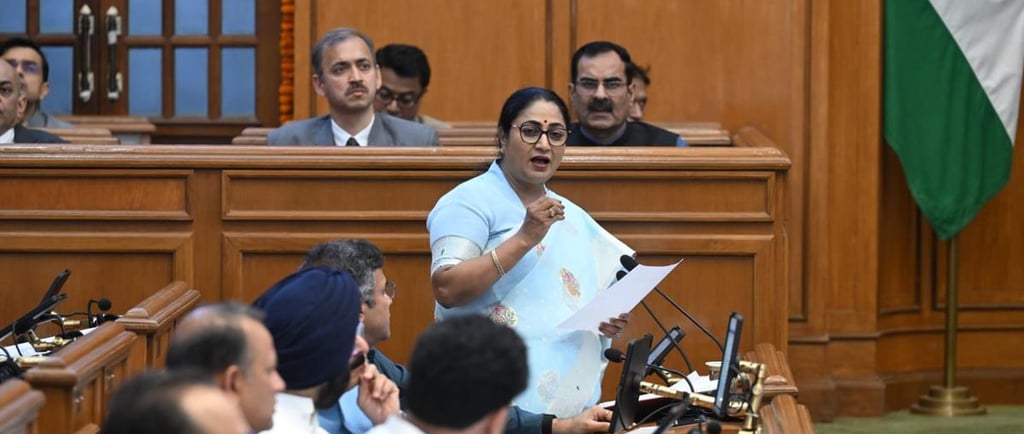
The Delhi Budget for FY 2026–27, presented by Chief Minister Rekha Gupta, marks a significant moment in the capital’s fiscal and policy trajectory. With a total outlay of ₹1,03,700 crore, the budget positions itself as a “Green Budget”, signalling a strong emphasis on environmental sustainability while continuing investments in infrastructure, human development, and targeted welfare schemes. The policy direction reflects an attempt to balance urban governance challenges with long-term sustainability goals, even as questions of implementation and fiscal prioritisation remain central.
At the core of this year’s budget is an ambitious commitment to environmental management. Nearly 21% of the total expenditure has been allocated to environment-related interventions, making it one of the most prominent thematic priorities. Key announcements include a ₹1,352 crore allocation for developing 750 km of dust-free roads, a measure aimed at tackling one of Delhi’s most persistent sources of air pollution. In addition, the government has committed to expanding green mobility through investments in electric vehicles and public transport infrastructure. These measures reflect a shift from piecemeal responses to a more integrated approach to pollution control. However, the effectiveness of these interventions will depend on whether they translate into measurable improvements in air quality, an area where past efforts have often fallen short.
Infrastructure development forms the second major pillar of the budget. The government has allocated ₹7,887 crore to urban development and ₹5,921 crore to the Public Works Department, alongside a ₹1,000 crore grant for road improvements under the Municipal Corporation of Delhi (MCD). Notably, the total allocation to the MCD stands at ₹11,666 crore, signalling an effort to strengthen local governance and improve civic service delivery. The budget also addresses regional imbalances through targeted spending ₹800 crore for unauthorised colonies, ₹300 crore for Trans-Yamuna development, and ₹787 crore for village development. These allocations indicate a recognition of the uneven nature of Delhi’s urbanisation and the need for inclusive spatial development. At the same time, the success of these measures will hinge on coordination between multiple agencies, a long-standing challenge in Delhi’s governance structure.
The budget also outlines several key initiatives in the education sector, continuing Delhi’s emphasis on human capital development. While overall allocations remain substantial, the focus this year is on expanding access and integrating technology into learning. Among the headline announcements is the provision of free laptops to meritorious Class 10 students, aimed at bridging the digital divide and enhancing learning outcomes. Complementing this is the distribution of free cycles to Class 9 girls, a scheme designed to improve school access and reduce dropout rates, particularly among female students. Additionally, ₹18.5 crore has been earmarked for student exposure visits in emerging fields such as artificial intelligence, indicating a forward-looking approach to skill development. The government has also proposed the establishment of an Education City in Narela, a Sports University in Mundka, and a National Law University, reflecting an ambition to position Delhi as a hub for higher education and specialised training.
In the health sector, the budget signals incremental expansion rather than structural overhaul. A ₹50 crore allocation has been made for a new medical college at Indira Gandhi Hospital, alongside plans to increase undergraduate and postgraduate medical seats. The government has also announced the establishment of 750 Ayushman centres and a new trauma centre, aiming to strengthen healthcare accessibility. A notable inclusion is the extension of Ayushman Bharat coverage to transgender persons, marking a step towards more inclusive healthcare policy. While these measures contribute to capacity building, the broader challenge of strengthening primary healthcare systems and ensuring service quality remains.
Social welfare continues to be an important component of the budget, with a mix of targeted schemes aimed at vulnerable groups. One of the key announcements is the issuance of 1,000 free e-auto permits for women, intended to enhance both mobility and economic participation. An additional 100 permits have been reserved for transgender persons, reinforcing the government’s focus on inclusion. The budget also provides ₹260 crore for free LPG cylinders during festivals such as Holi and Diwali, a continuation of subsidy-based welfare aimed at reducing household energy costs. These initiatives underscore a policy approach that combines economic support with identity-based targeting, though questions around long-term fiscal sustainability and impact assessment persist.
Water and sanitation infrastructure receive significant attention, with ₹9,000 crore allocated to the Delhi Jal Board for improving water supply and sewage systems. This is a critical intervention, given the persistent challenges of water scarcity, leakages, and uneven distribution across the city. Investments in this sector have the potential to generate substantial public health and quality-of-life benefits, provided they are accompanied by governance reforms and efficiency improvements.
Transport and mobility are closely linked to the budget’s environmental agenda. The government has reiterated its commitment to expanding the electric vehicle ecosystem and electric bus fleet, aiming to reduce vehicular emissions and improve urban mobility. These efforts align with Delhi’s broader climate goals, but their success will depend on the availability of charging infrastructure, policy incentives, and public adoption.
From a fiscal perspective, the budget adopts a moderately expansionary stance, with plans to raise ₹16,000 crore through market borrowing. This reflects a willingness to leverage debt for capital expenditure, particularly in infrastructure and urban development. While this approach can support growth and service delivery in the short term, it also underscores the importance of maintaining fiscal discipline and ensuring that borrowed funds are used efficiently.
Taken together, the Delhi Budget 2026–27 presents a comprehensive policy framework that seeks to address the city’s most pressing challenges pollution, infrastructure gaps, and social inequality while laying the groundwork for future growth. Its emphasis on environmental sustainability is particularly noteworthy, signalling a shift towards climate-conscious urban governance. At the same time, the continuation of welfare schemes and investments in human capital reflects a commitment to inclusive development.
However, the real test of the budget will lie in its implementation. Delhi’s complex administrative structure, involving multiple agencies and overlapping jurisdictions, has historically posed challenges to effective governance. Ensuring coordination between the Delhi government, the MCD, and other bodies will be crucial. Moreover, translating financial allocations into tangible outcomes whether in terms of cleaner air, better infrastructure, or improved public services will require robust monitoring and accountability mechanisms.
In conclusion, the Delhi Budget 2026–27 can be seen as an attempt to redefine the city’s development model, combining environmental priorities with infrastructure-led growth and targeted welfare. It is an ambitious blueprint that acknowledges both the opportunities and constraints of governing a rapidly growing metropolis. Whether it succeeds will depend not just on the scale of its allocations, but on the effectiveness of its execution.
Delhi Chief Minister Rekha Gupta presents the 2026-27 Budget during the Budget Session of Delhi Assembly in New Delhi on March 24, 2026