
Delhi Budget 2026: ‘Women, Welfare and a Green Push’
Delhi’s 2026–27 budget stakes out a clear political claim, Delhi is a city that will spend to secure its women and clean its air. Whether it delivers on that promise will depend less on the big numbers and more on how these schemes play out in mohallas, bus depots and slum clusters over the next years.
DELHI BUDGET (2026-27)
Delhi’s 2026–27 budget stakes out a clear political claim, Delhi is a city that will spend to secure its women and clean its air. Whether it delivers on that promise will depend less on the big numbers and more on how these schemes play out in mohallas, bus depots and slum clusters over the next years.
A budget with women at the centre
For once, women are not confined to a few scattered “ladies’ schemes” in a thick budget book, they sit close to the heart of the expenditure story. The Department of Women and Child Development (WCD) alone receives ₹7,406 crore, while the broader head of social security and welfare commands over ₹10,500 crore out of the ₹1,03,700‑crore budget. This is a deliberate choice in a city where women’s unpaid care work, precarious employment and unsafe public spaces are daily realities, not academic abstractions.
From cash transfers to mobility
The flagship Mahila Samriddhi Yojana, with a sizeable outlay of ₹5,110 crore, aims to provide a predictable financial cushion to women, signalling a shift from sporadic doles to more structured support. Layered on top are highly visible measures, ₹260 crore for free gas cylinders to women during Holi and Diwali, and ₹450 crore to keep bus travel free for women and transgenders in DTC buses both designed to ease the pressure on monthly household budgets and expand women’s mobility across the city.
The Delhi Lakhpati Bitiya Yojana tries to rewrite the script of daughters as “paraya dhan”, with the government committing ₹61,000 from birth to graduation so that each girl turns into a “lakhpati” with ₹1.2 lakh in her account, it gets ₹128 crore in this budget. This is more than symbolism, it is a long-horizon savings promise that, if implemented well, can subtly shift family incentives around girls’ education and delay early marriage. Women Haat outlets (₹10 crore) and Model Anganwadi Centres in every district (₹33 crore) attempt to build the physical spaces where women can both sell their work and secure nutrition and early childhood care for their children.
Safety, dignity and everyday welfare
The budget also recognises that empowerment without safety is hollow. A provision of ₹225 crore is earmarked for operation and maintenance of CCTV cameras and the installation of an additional 50,000 cameras, along with ₹50 crore to replace conventional street lights on PWD roads with energy-efficient smart LED systems moves that explicitly link safety, visibility and sustainability. Eleven new One Stop Centres for women in distress, backed by ₹16 crore, seek to provide the kind of integrated support legal, psychological, medical that survivors of violence have long struggled to access.
At the softer but no less important end, funds to install sanitary pad vending machines in government schools and to strengthen 611 creches under the Samarthya Palna scheme are acknowledgements that menstrual health and childcare are not “private matters” but public responsibilities. A network of welfare boards for gig workers, transgenders, and auto‑taxi drivers recognises the new fault lines of vulnerability in Delhi’s labour market, and implicitly admits that women and gender‑diverse workers are often at the sharpest edge of this precarity.
Mobility as empowerment: the DURGA bet
Perhaps the most striking intersection of women’s empowerment and the “green” narrative is the proposed DURGA scheme - Driving Upliftment and Rozgar for Women/Transgender Green e‑Auto. In its first phase, the government promises to help 1,000 women and 100 trans persons obtain new e‑auto permits, placing them literally in the driver’s seat of a traditionally male occupation. If executed with adequate training, credit support and safety guarantees, DURGA could transform not just incomes but also the gendered imagination of Delhi’s public spaces.
Free bus travel and e‑auto ownership, when combined, could redraw mobility maps for low‑income women from domestic workers commuting in the dark to young students travelling across the Yamuna for college. But these schemes will need meticulous follow‑through: depots must feel safe, complaint systems must work, and permits should not get captured by male proxies using women’s names.
Painting the budget green
On the climate front, the Delhi government has boldly declared this its first “Green Budget”, tagging 21.44 percent of total allocations ₹22,236 crore - as green. The dedicated budget for the environment and forest sector itself has risen from ₹505 crore last year to ₹822 crore, signalling that ecology is no longer a marginal line item. In an era when Delhi routinely tops global pollution rankings, this is a political statement as much as a policy one.
The Green Budget is anchored in a cluster of big-ticket initiatives: a ₹300‑crore “Pollution Control & Emergency Measures” scheme for mechanical road sweepers, anti‑smog guns and water sprinklers; ₹204 crore for the Municipal Corporation of Delhi specifically for pollution control; and ₹2 crore for an integrated monitoring system with war‑rooms, mobile apps and real‑time tracking. Behind these numbers is the recognition that Delhi’s residents especially women, children and the elderly live with the health costs of every smog episode in their lungs and on their medical bills.
Waste, energy and the circular economy narrative
The budget’s green ambitions extend to waste and energy. It commits to increasing waste processing capacity from 7,000 to 15,000 metric tonnes per day, backed by the expansion of waste‑to‑energy plants at Narela, Okhla, Ghazipur and Tehkhand. Around 1,500 tonnes of cow dung generated daily in the city are to be processed into energy an attempt to turn an urban‑rural waste problem into a circular‑economy opportunity that can, in principle, reduce emissions and fossil‑fuel dependence.
Perhaps most conceptually ambitious is the proposed Carbon Credit Monetisation Scheme, which promises to convert emission reductions into economic value through a robust MRV - Measurement, Reporting and Verification system. If GNCTD can actually build a credible MRV architecture and link it to green investments by its own agencies, Delhi could become a test case for how cities in the global South finance climate action.
Where women and green agendas meet
The real innovation in this budget is less in isolated schemes than in the way its social and green priorities intersect. Electric buses, depot electrification and the Delhi Electric Vehicle Policy 2.0 are rightly sold as climate measures, but they are also enablers of safer, cheaper mobility for women, especially when paired with free bus travel and higher service frequency. The DURGA e‑auto scheme embodies this intersection most clearly, it is simultaneously an employment programme for marginalised genders, a last‑mile connectivity solution and a clean‑mobility intervention.
Similarly, Model Anganwadi Centres, creches and slum‑level infrastructure under DUSIB sit squarely inside the “welfare” box but are also critical to building climate‑resilient neighbourhoods with safer buildings, better drainage and more organised service delivery in the very communities that will be hit first and hardest by extreme weather. In that sense, the budget hints at an understanding that gender justice and climate justice are not parallel tracks but intertwined agendas.
The test: delivery, not declarations
For all its ambition, this budget will ultimately be judged on outcomes, not adjectives. Tagging 21.44 percent of the budget as “green” is laudable, but without transparent criteria, independent audits and annual outcome reporting, there is a risk that the Green Budget becomes a branding exercise rather than a binding discipline. The same is true of women‑centric schemes, large allocations can quickly dissolve into fragmented benefits if application processes are complex, if front‑line workers are overburdened, or if leakages and middlemen creep in.
Delhi’s women have heard promises before from panic buttons that don’t work to buses that never arrive on time. This budget offers them something more substantial, money in accounts, subsidised essentials, safer streets, and a genuine shot at economic autonomy through schemes like Mahila Samriddhi, Lakhpati Bitiya and DURGA. Whether the 2026–27 budget is ultimately remembered as a turning point for women’s empowerment and green governance, or just another well‑crafted speech, will depend on how vigorously citizens, civil society and the media hold the government to these numbers over the next twelve months.
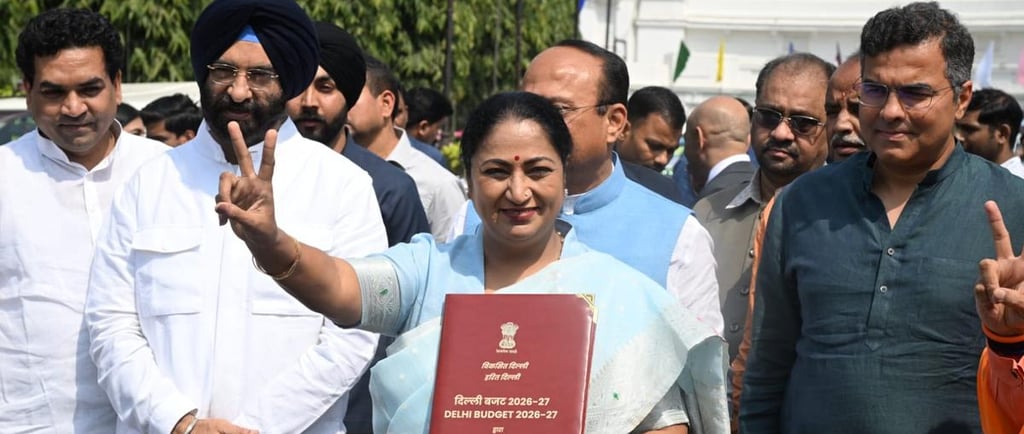
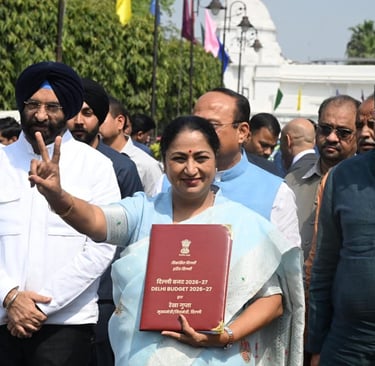
Delhi Chief Minister Rekha Gupta presents the 2026-27 Budget during the Budget Session of Delhi Assembly in New Delhi on March 24, 2026