Delhi's Draft Electric Vehicle Policy 2026–2030: An Assessment of Incentive Structures, Transition Timelines, and Governance Implications
On April 11, 2026, the Government of the National Capital Territory of Delhi released the Draft Delhi Electric Vehicle (EV) Policy 2026–2030, marking a decisive shift in the city's clean mobility agenda. Building on the foundational 2020 EV Policy, this second-generation framework introduces stricter phase-out timelines for internal combustion engine (ICE) vehicles, a tiered incentive structure spanning two-, three-, and four-wheelers, and an expanded charging infrastructure mandate. The draft is currently open for 30 days of public consultation before formal notification.
POLICY BRIEF
Executive Summary
On April 11, 2026, the Government of the National Capital Territory of Delhi released the Draft Delhi Electric Vehicle (EV) Policy 2026–2030, marking a decisive shift in the city's clean mobility agenda. Building on the foundational 2020 EV Policy, this second-generation framework introduces stricter phase-out timelines for internal combustion engine (ICE) vehicles, a tiered incentive structure spanning two-, three-, and four-wheelers, and an expanded charging infrastructure mandate. The draft is currently open for 30 days of public consultation before formal notification.
I. Context and Rationale
Delhi remains one of the most polluted megacities in the world. Transport emissions account for approximately 23% of total particulate matter (PM) pollution in the capital, and two-wheelers alone contribute nearly 67% of transport-related emissions. With over 13 million registered vehicles and a daily influx from neighbouring states, the challenge of decarbonising urban mobility is both urgent and structurally complex.
The 2020 EV Policy was a landmark initiative — it set a 25% EV share target in new registrations by 2024 and introduced the first wave of demand-side subsidies. However, EV penetration remained below targets by 2025, particularly in the four-wheeler segment, constrained by high upfront costs, infrastructure gaps, and limited consumer awareness. The Draft Policy 2026–2030 responds with a more assertive regulatory posture: hard phase-out deadlines, degressive fiscal incentives, and a city-scale charging infrastructure mandate.
II. Key Provisions of the Draft Policy
A. Phase-Out Timelines for ICE Vehicles
The draft establishes a sequenced, category-specific phase-out regime:
January 1, 2026 (already in effect): No new ICE two-wheelers or light goods vehicles (up to 3.5 tonnes) permitted to join aggregator-based services (Ola, Uber, Swiggy, Zomato). Existing BS-VI two-wheelers in such fleets have a transition window until December 31, 2026.
January 1, 2027: Complete ban on registration of new petrol/CNG three-wheelers (auto-rickshaws); only electric three-wheelers eligible for fresh registration.
April 1, 2028: Only electric two-wheelers permitted for new registrations effectively phasing out all new petrol scooters and motorcycles.
By March 2030: 30% of school bus fleets must be electric; all newly procured government vehicles must be electric; DTC and the Transport Department to exclusively induct electric buses.
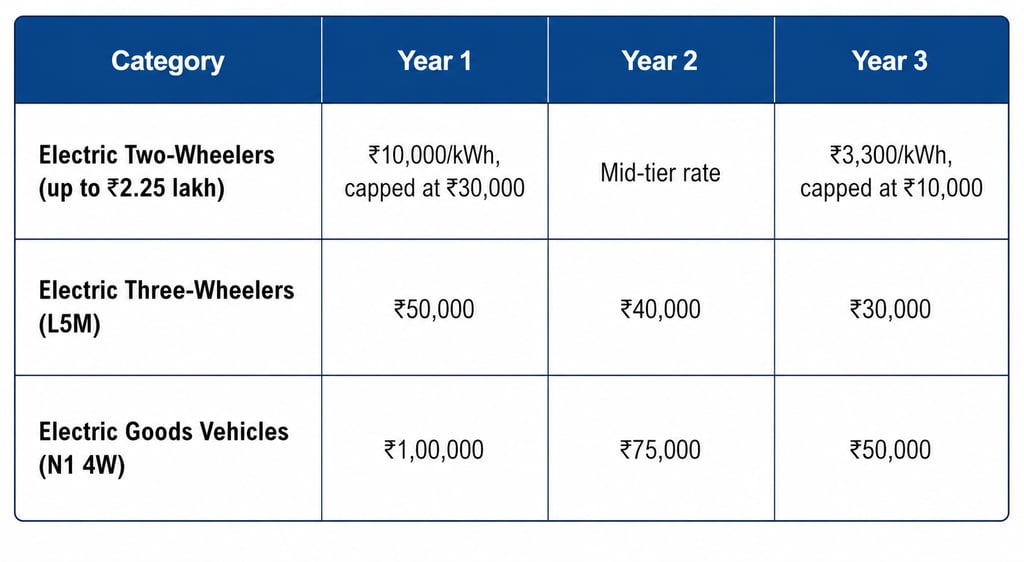
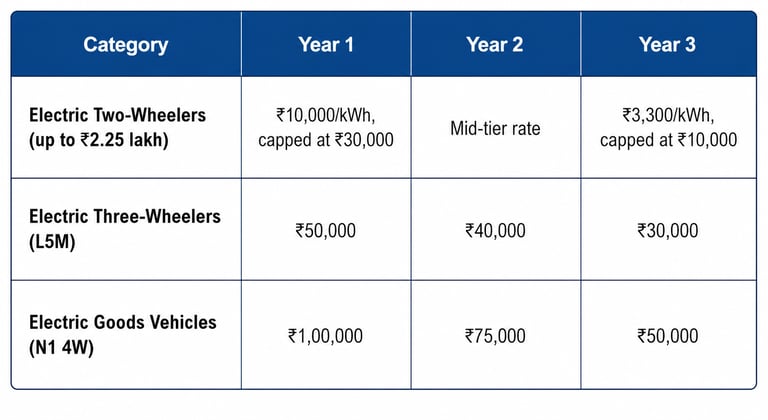
B. Demand-Side Fiscal Incentives
The policy adopts a degressive subsidy model to incentivise early adoption while managing long-term fiscal exposure:
For private electric cars up to ₹30 lakh, the draft does not renew direct purchase subsidies but provides a 100% exemption on road tax and registration fees until March 31, 2030. EVs priced above ₹30 lakh receive no fiscal exemptions. In a notable inclusion, strong hybrid vehicles up to ₹30 lakh are offered a 50% concession on road tax and registration fees positioning hybrids as a recognised transitional technology.
C. Scrappage Incentive Framework
The draft introduces a Vehicle Scrappage Incentive Scheme to remove older, more polluting vehicles from Delhi's roads:
· Eligible vehicles: BS-IV or older, Delhi-registered, scrapped at authorised centres
· Time-bound condition: EV must be purchased within six months of receiving a Certificate of Deposit
· Incentive quantum:
o Electric two-wheelers: ₹10,000
o Electric three-wheelers: ₹25,000
o Electric four-wheelers: ₹1,00,000 (limited to first 1,00,000 claimants)
· Disbursement: Direct Benefit Transfer (DBT) to verified owner accounts
D. Charging Infrastructure Mandate
Delhi Transco Limited (DTL) will anchor the city-wide charging network:
· Approximately 18,000 public charging stations to be installed across Delhi by 2030
· Mandatory installation of at least one public charging point at every EV dealership
· Promotion of battery swapping infrastructure, especially for two- and three-wheelers
· Single-window clearance for home charging installations
· Coordinated land allocation across district authorities and land-owning agencies
E. EV Fund and Governance Architecture
A dedicated EV Fund will finance implementation, drawing from state budget allocations, Central schemes including PM E-Drive, and other approved sources. All incentives are routed through DBT, with eligibility linked to verified vehicle ownership and formal scrappage documentation.
III. Assessment: Strengths of the Draft Policy
1. Regulatory Clarity and Sequenced Timelines
The phase-out schedule is well-sequenced — beginning with commercially tractable segments (aggregator fleets and three-wheelers) before addressing the mass two-wheeler market. This minimises economic disruption and gives the supply chain time to scale.
2. Degressive Subsidy Design
The declining subsidy model for two-wheelers and three-wheelers is fiscally prudent. It creates a front-loaded incentive for early movers and avoids long-term lock-in of public expenditure in segments expected to achieve price parity with ICE vehicles within the policy horizon.
3. Hybrid Inclusion as a Bridge Strategy
The 50% road tax concession for strong hybrids reflects a pragmatic acknowledgment that the premium car segment may not transition fully to battery EVs within this policy period. Recognising hybrids as a transition option prevents consumers from remaining stranded on older, more polluting platforms.
4. Scrappage-Linked Incentives for Fleet Renewal
Linking scrappage to EV purchase — via a time-bound window and DBT disbursement — is an effective mechanism for removing high-emission legacy vehicles. The ₹1 lakh incentive for four-wheelers is a meaningful demand stimulator in the sub-₹30 lakh segment.
5. Infrastructure as a Policy Pillar
Unlike many state EV policies that treat infrastructure as secondary, the Delhi draft integrates charging network expansion as a co-equal goal, with DTL as the designated implementing agency. The 18,000-station target and mandatory dealership provision are substantive commitments.
IV. Assessment: Gaps and Concerns
1. Equity Deficit in the Four-Wheeler Segment
The withdrawal of direct purchase subsidies for private electric cars disproportionately affects middle-income households in the ₹15–30 lakh vehicle segment, for whom road tax waivers alone may be insufficient to offset the upfront cost premium of EVs over comparable ICE models.
2. Hybrid Policy Inconsistency
The draft does not define "strong hybrid" with sufficient technical specificity. Without clear eligibility criteria — such as minimum electric range or battery capacity thresholds — there is a risk of regulatory arbitrage by automakers misclassifying mild or micro-hybrids to access concessions. Standardised definitions, aligned with SIAM or BIS norms, are essential.
3. Gig Worker Transition Support Deficit
The aggregator fleet mandate imposes transition costs on delivery and ride-hail workers who often bear vehicle upgrade costs under lease or EMI structures, yet no targeted support scheme for gig workers is articulated in the current draft. This is a significant omission given that two-wheeler gig workers represent the most financially vulnerable segment of the transition.
4. Scrappage Ecosystem Readiness
The scrappage incentive scheme is contingent on a robust network of authorised scrapping centres. Delhi currently has limited such infrastructure, and the capacity to handle a potential surge — particularly if the ₹1 lakh four-wheeler incentive triggers significant demand — has not been assessed in the draft.
5. Absence of Fiscal Projections
The draft does not include fiscal impact estimates for incentive schemes, projected uptake across categories, or a detailed financing plan for the EV Fund. This limits independent assessment of the policy's fiscal sustainability and raises questions about absorptive capacity.
6. Inter-State Vehicle Challenge
Delhi's pollution is significantly exacerbated by vehicular traffic from Haryana, Uttar Pradesh, and Rajasthan. The draft's jurisdiction is confined to Delhi-registered vehicles, with no mechanism for coordinating regional phase-out timelines or incentivising inter-state EV adoption.
V. Recommendations
The Civic Policy Forum advances the following for consideration during the public consultation phase:
1. Introduce a Targeted Gig Worker EV Scheme: Design a separate financial assistance programme for delivery and ride-hail workers, including interest-free EMI support or EV leasing subsidies coordinated with aggregator platforms and NBFC partners.
2. Define Hybrid Eligibility Criteria: Adopt SIAM/BIS-aligned technical definitions to prevent misclassification and ensure the 50% road tax benefit flows exclusively to genuine strong hybrids.
3. Publish a Fiscal Impact Statement: Include category-wise incentive outflow estimates, projected uptake rates, and a medium-term EV Fund financing plan as part of the final notified policy.
4. Scale Up Authorised Scrapping Infrastructure: Commission a rapid capacity assessment of scrapping centres in Delhi and initiate tie-ups with national-level facilities to operationalise the scrappage scheme without bottlenecks.
5. Establish a Regional Coordination Mechanism: Engage the NCR Planning Board and NCRTC to develop a coordinated EV roadmap for the NCR region, particularly for commercial vehicles and buses crossing state borders.
6. Restore Targeted Support for Low-Income Car Buyers: Consider reintroducing a time-limited, income-tested direct subsidy for first-time EV buyers in the ₹15–25 lakh segment to complement the road tax waiver.
VI. Conclusion
The Draft Delhi EV Policy 2026–2030 represents a substantive advancement in India's urban clean mobility agenda. Its phase-out timelines are decisive, its incentive architecture is fiscally thoughtful, and its inclusion of hybrids reflects a pragmatic engagement with consumer transition realities. The 18,000-station charging infrastructure target, if implemented effectively, would position Delhi as a model for other Indian cities.
However, the policy's ambition must be matched by institutional depth. The absence of a gig worker support framework, unresolved questions about scrapping ecosystem readiness, and the lack of fiscal projections are not minor omissions — they are potential execution failures that could undermine the policy's most transformative elements. The Civic Policy Forum urges the Government of NCT Delhi to use the ongoing 30-day consultation window to engage meaningfully with auto-rickshaw driver unions, gig worker collectives, EV manufacturers, and charging infrastructure providers before finalising the policy.
The Civic Policy Forum (CPF) is a Delhi-based independent think tank working at the intersection of governance, public finance, and social policy. For queries, collaboration, or citations: office@civicpolicyforum.in
© 2026 Civic Policy Forum | This brief may be freely cited with attribution.