Delhi's Pollution Crisis: 2025 Progress and Policy Priorities
POLICY BRIEF
Download the PDF: Delhi Pollution Crisis: 2025 Progress and Policy Priorities
The Challenge
Delhi's air quality remains a critical urban governance issue. Yet 2025 brings reason for cautious optimism. The city has achieved its best annual air quality performance since the COVID-19 lockdown year, hitting a milestone of 200 days with healthy air nearly double the 110 days recorded in 2016. Winter months, however, still plunge the city into hazardous pollution zones.
The Delhi government's Air Pollution Mitigation Plan 2025 represents a decisive shift toward coordinated, multi-sectoral action. But critical questions emerge: Are these interventions sufficient to break the winter crisis cycle? Can momentum be sustained and scaled across the National Capital Region? This brief examines 2025 progress, identifies implementation gaps, and proposes actionable policy priorities.
What the Data Reveals
Five years of air quality monitoring tell a story of slow but measurable progress. Delhi's average AQI has stabilized around 139 in 2025, an improvement of 15–18% compared to previous years. Most significantly, the city has spent 200 days this year breathing air classified as "acceptable" nearly double the 110 days recorded in 2016, representing an 82% improvement in healthy-air accessibility.
The improvement extends to particulate matter. PM2.5 concentrations have dropped to 74 µg/m³ (January–August 2025), down from 86 in 2024 a 14% reduction. Similarly, PM10 levels fell to 169 µg/m³ from 192 the previous year the lowest since 2018, representing the most significant particulate matter decline in seven years.
Yet progress masks a persistent vulnerability: when winter arrives, so does crisis. December 2025 saw AQI readings spike to 340 (hazardous), a reminder that seasonal meteorological patterns, crop burning in neighboring states, and vehicular congestion continue to overwhelm even optimized governance measures.
Government Action: A Multi-Sectoral Response
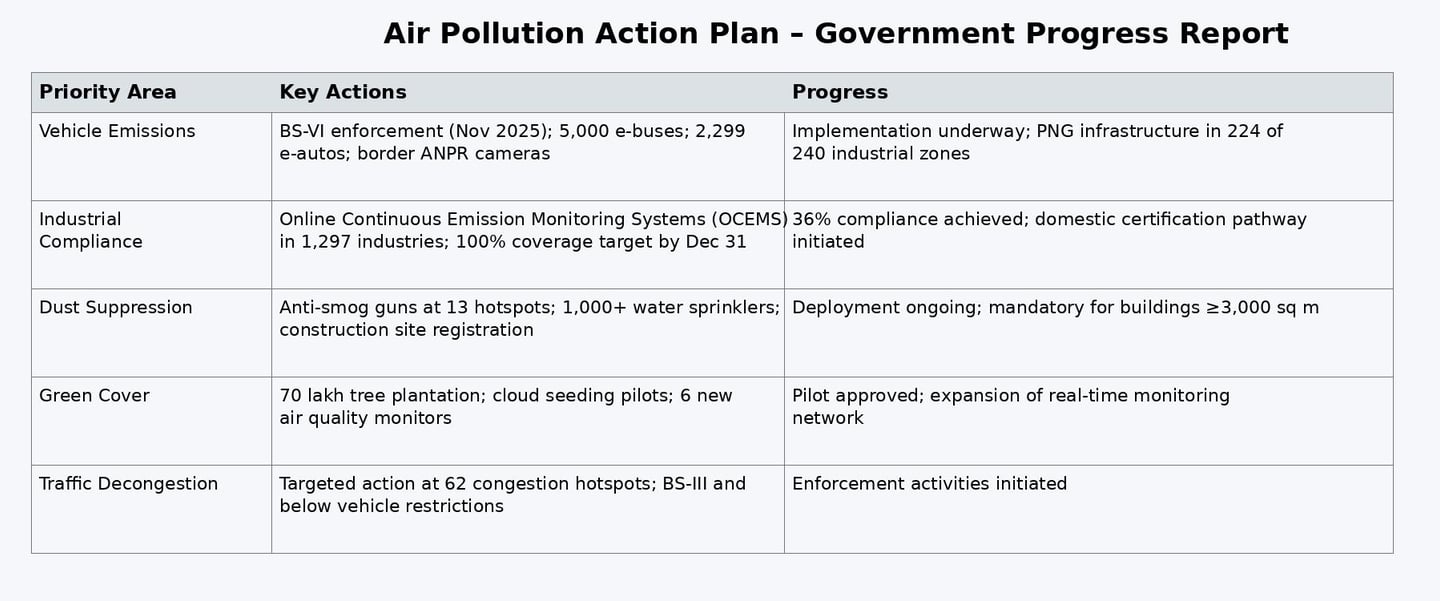
In June 2025, Chief Minister Rekha Gupta launched a comprehensive Air Pollution Mitigation Plan addressing the complex sources of Delhi's air crisis. The approach spans five critical areas:
What's Working—and What Isn't
The progress is real. The 200-day milestone reflects genuine policy impact. Union Environment Ministry officials credit the coordinated sectoral approach—particularly BS-VI vehicle standards and OCEMS deployment with stabilizing air quality outside the winter crisis window. These are not quick fixes but rather necessary infrastructure shifts requiring sustained multi-year commitment and cross-jurisdictional coordination.
But critical gaps remain. Winter pollution spikes suggest that seasonal drivers—stubble burning in Punjab and Haryana, meteorological stagnation, heating loads—overwhelm even optimized local governance. Inter-state coordination remains fragmented; the National Capital Region operates as separate fiefdoms rather than an integrated air management zone. OCEMS rollout faces vendor delays and technical certification bottlenecks. Real-time monitoring of high-emission vehicles remains nascent. And legacy pollution sources particularly landfill sites like Ghazipur (clearance target: September 2028)—continue contributing to baseline pollution.
The challenge isn't policy design but execution fidelity at scale.
The Path Forward: Five Priorities
1. Accelerate industrial compliance: Fast-track OCEMS vendor certification and enable smaller industries to access monitoring at shared facilities. Don't let bureaucracy slow momentum.
2. Deploy vehicle emission tech: Implement real-time remote-sensing cameras to identify high-polluters and enable dynamic enforcement. Technology exists; deployment at 100+ hotspots is the gap.
3. Integrate air management across NCR: Create binding inter-state protocols on stubble burning, construction restrictions, and traffic management. Delhi alone cannot solve an eight-state airshed problem.
4. Strengthen winter response: Pre-position alternative heating systems, pre-allocate construction permits on seasonal basis, and scale cloud-seeding capacity before October.
5. Measure what matters: Publish monthly implementation data by sector. Public transparency drives accountability and identifies bottlenecks before they compound.