
India's Gold Rush Home: Why the RBI Is Reversing the 1991 Airlift
As the Strait of Hormuz closes and the rupee slides, India's central bank is moving gold back to domestic vaults at a pace not seen in decades and the reasons run deeper than portfolio management
OPINION
From humiliation to homecoming
In 1991, India's forex reserves fell below $1 billion, enough for three weeks of imports. To stave off default, the RBI airlifted 67 tonnes of gold to the Bank of England and the Union Bank of Switzerland, pledging it as collateral for $600 million in emergency credit. The Chandra Shekhar government collapsed shortly after.
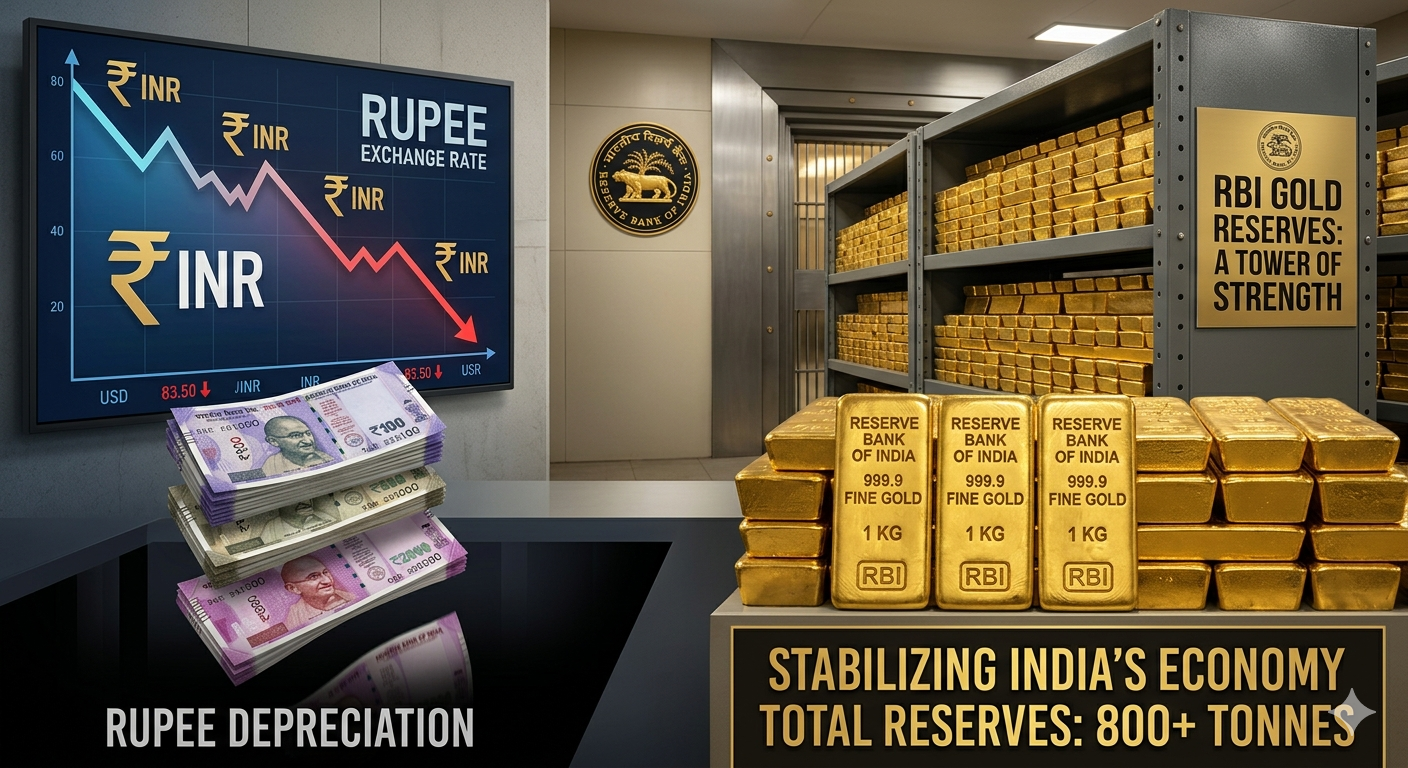
Three decades on, the RBI is running the operation in reverse. Between March 2023 and March 2026, it repatriated roughly 379 tonnes of gold from the Bank of England and the Bank for International Settlements. Gold held on Indian soil jumped from 38% to 77% of total holdings. The RBI now holds 880.52 metric tonnes, valued at $122 billion, making up 16.7% of India's $691 billion forex reserves.
The Moscow precedent
The trigger came from outside India. In February 2022, Western nations froze nearly $300 billion of Russia's central bank reserves after the invasion of Ukraine. Moscow had spent years assembling a $630 billion war chest. Two-thirds of it, held in foreign accounts, became inaccessible overnight. Central bank gold purchases that year hit a five-decade high, according to the World Gold Council. The message for every non-aligned central bank was plain: reserves stored abroad exist at the pleasure of the host jurisdiction. Gold held at home carries no counterparty risk.
Why it matters right now
The RBI's largest annual repatriation, 168 tonnes in FY 2025-26, coincides with a live stress test. Iran blockaded the Strait of Hormuz in early March 2026, triggering what the IEA has called the largest supply disruption in the history of the global oil market. India imports 85% of its crude. Roughly half its crude, 60% of its LNG, and nearly all its LPG transits that corridor. Brent surged past $105 per barrel. The rupee hit a record low of 95.63 against the dollar.
On 10 May 2026, Prime Minister Modi urged Indians to stop buying gold for a year, cut foreign travel, and conserve fuel. The last time an Indian PM made that kind of austerity appeal was 1991.
What gold does for the balance sheet
India's $691 billion forex buffer covers about 11 months of imports, a vastly larger cushion than 1991's three weeks. Gold plays a particular role within it. Unlike dollar-denominated securities or deposits with foreign central banks, physical gold held domestically cannot be frozen, sanctioned, or stranded by a shipping blockade. It is the only major reserve asset whose accessibility is entirely within India's control.
The RBI has accepted a deliberate trade-off in the process. Gold at the Bank of England is easier to deploy in repo operations and currency swaps. Domestic gold is safer from seizure, but less liquid. For a country with a $175 billion annual oil import bill, that cost is real. The calculation is that in today's geopolitical climate, the risk of losing access outweighs reduced liquidity.
The pattern
India is not acting alone. Poland, China, Uzbekistan, and several emerging-market central banks have accelerated gold accumulation since 2022. In Q1 2026, central banks globally added a net 244 tonnes, well above the five-year average. Gold's share in global central bank reserves has surpassed that of US Treasuries for the first time since 1996. Across borders, the logic is consistent: when financial sanctions become a tool of statecraft, the physical location of reserves becomes a strategic question.
The 1991 airlift taught India what happens when reserves run out. The 2022 Russia freeze showed what happens when reserves exist but cannot be reached. The 2026 repatriation is the institutional answer to both: make sure the gold is already home before you need it.


Debodipta Nandan is an independent public policy professional working at the intersection of digital governance and strategic communications. She writes on regulation, media, and emerging technology. Views expressed are personal.