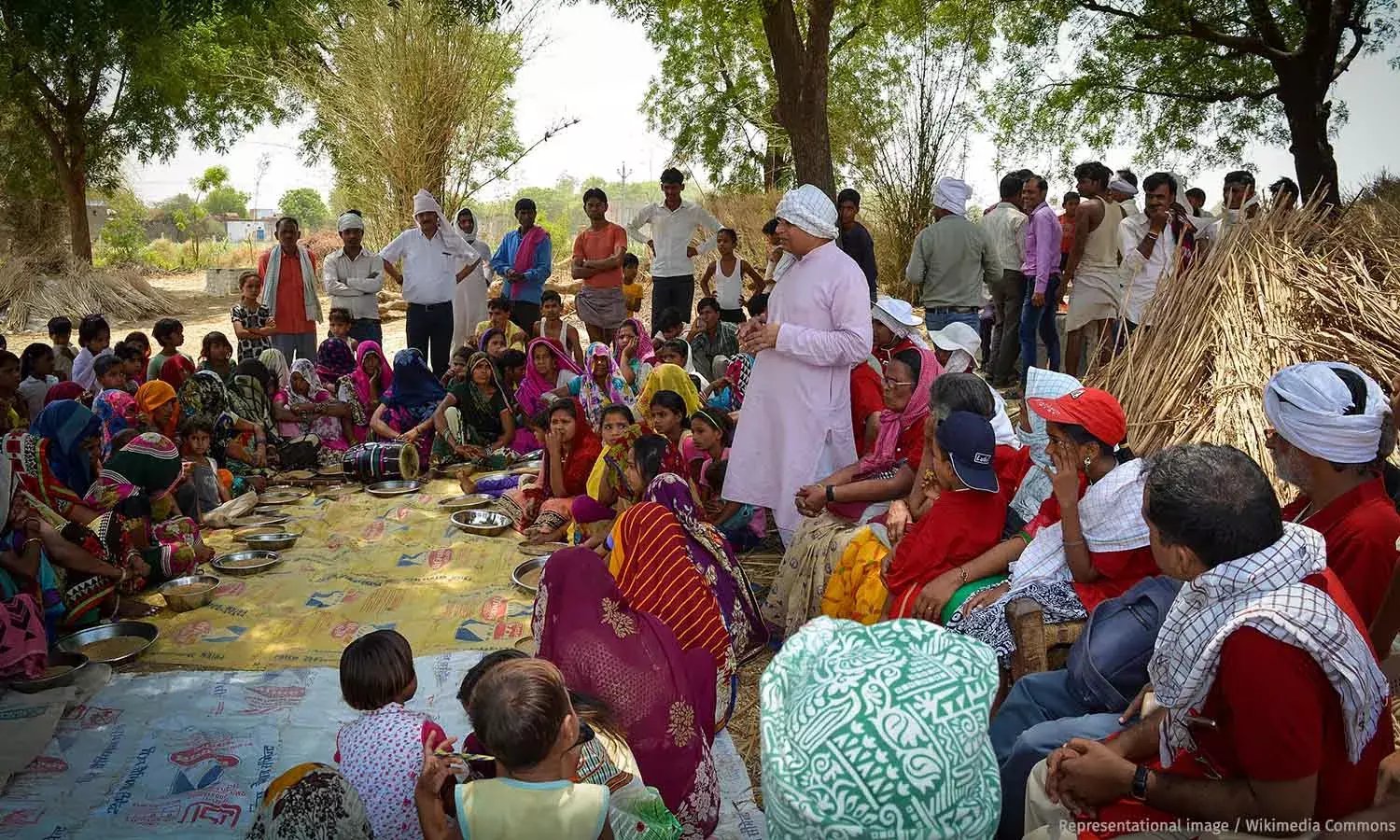
Strengthening India's Third Tier: A Review of Reforms in Local Governance
More than 2.5 lakh Panchayats now operate through digital systems, over three lakh villages have been surveyed through drone technology, and a rapidly growing share of rural local bodies has transitioned to online financial transactions. These metrics signal a governance architecture undergoing profound transformation.
OPINION
India's local governance system stands at a critical inflection point in 2026. The Ministry of Panchayati Raj's Annual Report for 2024–25 reveals a certain answer that defines contemporary decentralisation; visible technological progress and institutional expansion coexist with persistent organizational fragility. More than 2.5 lakh Panchayats now operate through digital systems, over three lakh villages have been surveyed through drone technology, and a rapidly growing share of rural local bodies has transitioned to online financial transactions. These metrics signal a governance architecture undergoing profound transformation. Yet this machinery of modernization operates within structural constraints like trained staff shortages, uneven planning capacity, and protracted fund delays that reveal how India's third tier remains a work in progress. Understanding this duality is essential to appreciating both the genuine achievements of decentralization and the hard work that lies ahead.
A Digital Revolution at the Grassroots
The digitalisation of India's Panchayat system in 2025 represents one of the most ambitious governance technology deployments globally. The headline numbers are striking: 2.39 lakh Gram Panchayats (GPs) commenced online payments during 2024–25, facilitating nearly Rs. 32,401 crores in direct transfers to beneficiaries and vendors. This transition to digital accounting has not merely improved efficiency; it has fundamentally altered the transparency architecture of rural governance. By eliminating cash intermediaries and creating permanent digital trails, online payments have reduced opportunities for leakage and enhanced citizen oversight of public expenditure at the most decentralized level.
The technological infrastructure underpinning this shift reflects government commitment to closing the rural-urban digital divide. The SabhaSaar platform, launched in August 2025, exemplifies this innovation. An artificial intelligence-powered tool that generates structured minutes from Gram Sabha proceedings in real time, SabhaSaar operates across fourteen Indian languages through integration with the Bhashini platform. This linguistic accessibility is particularly significant: it ensures that governance documentation and transparency benefits extend equally to speakers of regional languages, not merely to English-literate elites. For a village in Tamil Nadu, Assam, or Rajasthan, this means Gram Sabha decisions are now recorded, searchable, and publicly accessible in their own language—a direct expansion of democratic participation.
The eGramSwaraj portal represents the integrated backbone of this digital transformation. Covering more than 2.7 lakh institutions, this comprehensive platform consolidates planning, budgeting, accounting, and monitoring functions into a single accessible interface. Panchayats no longer maintain fragmented records across multiple ledgers and officials; instead, all financial and administrative data flows through a standardized digital system. The Meri Panchayat mobile application complements this institutional infrastructure by enabling citizens to track local budgets, monitor project implementation, and directly observe their representatives' work in real time. This citizen-facing technology embodies the principle that governance transparency is not a bureaucratic formality but a constitutional promise made tangible through digital access.
Mapping Rural Prosperity: The SVAMITVA Schema of Land Rights
The SVAMITVA (Survey of Villages and Mapping with Improvised Technology in Village Areas) scheme demonstrates how drone technology and digital mapping are transforming rural property rights. As of August 2025, drone surveys have been completed in 3.23 lakh villages, with 2.63 crore property cards prepared in 1.73 lakh villages. This represents the largest-scale drone mapping exercise in the developing world, with profound implications for rural economic empowerment.
The significance of these property cards extends far beyond administrative documentation. Rural households historically lacked formal proof of residential property ownership, a situation that trapped entire communities in informal land markets and excluded them from institutional credit. With SVAMITVA property cards, villagers now possess digitally verified ownership documentation, enabling them to access formal bank credit, participate in property markets with secure legal standing, and resolve disputes through evidence rather than personal testimony. For rural women, who frequently lack traditional inheritance documentation, these property cards represent expanded economic agency. The scheme has empowered villagers with secure land titles, enabled easier access to bank loans, boosted Panchayat revenues through improved property tax collection, and fundamentally improved dispute resolution mechanisms.
Physical Infrastructure: Bridging the Capacity Gap
While digital infrastructure addresses information asymmetries, the government has simultaneously invested in physical spaces for Panchayat administration. During 2024, the Ministry sanctioned funds for the construction of Gram Panchayat Bhawans in 4,604 locations, ensuring that all Gram Panchayats with populations exceeding 3,000 will have dedicated office premises. This saturation approach to Panchayat building construction addresses a long-standing infrastructure deficit that had constrained effective governance delivery.
The importance of these dedicated office spaces should not be underestimated. Historically, many Panchayats operated from temporary structures, private homes of elected leaders, or school buildings borrowed during non-instructional hours. This precarious administrative infrastructure reflected a deeper institutional fragility, elected Panchayat members often lacked even basic office equipment, internet connectivity, or secure spaces for confidential governance functions. By ensuring every Gram Panchayat above a minimum population threshold has a proper administrative building, the government signals institutional permanence and professional capacity. These spaces enable proper record-keeping, secure storage of documents, citizen grievance registration, and the physical accommodation of digital governance infrastructure.
Tribal Governance and Constitutional Implementation
The Provisions of the Panchayats (Extension to Scheduled Areas) Act, 1996 (PESA Act), governs Panchayat operations in India's tribal regions, recognizing the distinctive governance traditions and constitutional protections of these communities. During 2024, the Ministry undertook substantial efforts to strengthen PESA implementation through a series of impactful workshops and conferences. Training modules were translated into local tribal languages to ensure accessibility and effectiveness at the grassroots level, reflecting a deliberate approach to constitutional inclusivity.
This emphasis on PESA implementation reflects constitutional commitment to tribal self-determination. The PESA framework preserves customary institutions, recognizes community decision-making authorities, and protects communal property rights in ways that standard Panchayat structures do not. By strengthening PESA implementation through localized capacity building, the government acknowledges that decentralization must be culturally responsive, not universally uniform.
Financial Accountability and Gram Sabha Oversight
Financial accountability mechanisms have been strengthened through routine audit closure procedures. For 2023–24, 93 per cent of Gram Panchayats successfully closed their annual account books, representing significant improvement in financial discipline and record-keeping. This near-complete account closure indicates that the vast majority of Panchayats are maintaining systematic financial records and submitting to regular audit scrutiny—a marked improvement from historical patterns of delayed or incomplete accounts.
The People's Plan Campaign for 2025–26 represents an evolution in participatory governance. Gram Sabhas are tasked with reviewing and updating Gram Panchayat Development Plans using digital platforms including eGramSwaraj, Meri Panchayat App, and Panchayat NIRNAY. This process requires Sabhas to assess progress on earlier works, identify delays, and reprioritize unfinished projects—particularly those linked with unspent Central Finance Commission grants. By making this planning process digital and participatory, the government institutionalizes citizen oversight while improving project execution. The Panchayat Advancement Index guides this planning process, while tools like SabhaSaar enhance deliberation effectiveness.
Youth Engagement and Democratic Participation
Recognizing that local democracy requires generational renewal, the Ministry introduced the Model Youth Gram Sabha framework in October 2025. This comprehensive approach seeks to translate the vision of participatory democracy into practical institutional reality, with particular emphasis on engaging young people in village governance and decision-making processes. Young Gram Sabhas serve as civic education platforms, making participation aspirational rather than obligatory. By expanding such models to schools and colleges, India can cultivate a generation for whom local governance participation is normalized rather than exceptional.
Broadband Connectivity and Rural Digital Access
The BharatNet project aims to provide high-speed broadband to every Gram Panchayat, addressing the digital infrastructure prerequisites for e-governance. Over 13 lakh fibre-to-the-home connections have been commissioned, supporting services across education, health, governance, and agriculture. As of June 2025, nearly 6.26 lakh of India's 6.44 lakh villages already possess internet access via 3G or 4G networks. This near-universal rural digital access represents a prerequisite transformation: e-governance platforms are merely inert websites without connectivity. The steady expansion of BharatNet ensures that digital tools like eGramSwaraj and Meri Panchayat reach villagers irrespective of their geographic isolation or economic status.
Infrastructure and Spatial Planning
The Gram Manchitra geo-spatial planning tool represents government effort to modernise village development planning. This platform provides Panchayats with evidence-based mapping capabilities, enabling infrastructure planning decisions grounded in actual geographic and demographic data rather than estimation. Combined with drone surveys, Gram Manchitra allows Panchayats to map infrastructure deficits, prioritise development works based on spatial need, and communicate development plans visually to villagers. This represents a shift from narrative planning documents toward data-driven, visualised governance.
National Recognition and Performance Rankings
International recognition of India's local governance innovations underscores their significance. At the National Awards for e-Governance 2025, a new category was specifically introduced for grassroots initiatives, with Gram Panchayats in Maharashtra, Tripura, Gujarat, and Odisha honoured for adopting digital platforms to improve transparency and service delivery. This institutional recognition signals that decentralisation is not a peripheral policy concern but a central component of India's governance modernisation.
The Devolution Index—a periodic ranking of states based on their degree of devolution to local bodies—provides competitive incentive structures. Remarkable progress is evident: Uttar Pradesh's journey from 15th to 5th place exemplifies the transformative power of focused governance reforms, with the state revolutionising its accountability framework through innovative transparency initiatives and robust anti-corruption measures. Tripura's impressive leap from 13th to 7th place, particularly in revenue generation and fiscal management, demonstrates that smaller states achieve excellence in local governance through systematic policy effort.
Addressing the Sustainability Challenge: Trained Personnel and Institutional Capacity
Despite these achievements, the Ministry itself acknowledges persistent challenges that constrain decentralisation effectiveness. The shortage of trained staff remains acute: many Panchayats lack adequate administrative personnel with skills in digital systems management, financial accounting, and development planning. While infrastructure and digital platforms provide the hardware and software of governance, trained human resources provide the institutional operating system. A Gram Panchayat Bhawan equipped with eGramSwaraj and internet connectivity nevertheless struggles if staffed by untrained personnel unfamiliar with digital systems.
The uneven distribution of planning capacity across states and regions further complicates decentralisation. While some states have developed institutional expertise in Panchayat planning and capacity building, others lack the administrative infrastructure to support widespread implementation. This geographic unevenness reflects broader patterns of state-level governance capacity disparities that persist despite national policy frameworks.
Fund flow delays, while not specific to 2025, continue to constrain Panchayat operations. The constitutional commitment to time-bound Central Finance Commission transfers requires state governments to channelise these funds quickly to local bodies. Delays at the state level, however, often prevent Panchayats from utilising allocated budgets within stipulated timeframes, forcing work postponement and efficiency loss.
The Vision of Empowered Local Bodies
These investments in decentralisation reflect a larger constitutional vision: that of Gram Swaraj (village self-rule) as the foundation of India's development model. The 73rd Constitutional Amendment (1992) established Panchayati Raj as a constitutional institution, recognising that sustainable development must be rooted in local decision-making rather than centrally determined policies. The reforms of 2024–25 represent operationalisation of this constitutional principle through technology and capacity building.
The Ministry's efforts are explicitly aligned with the vision of "Viksit Bharat by 2047," where empowered Panchayats serve as the bedrock of India's rural transformation. This is not merely rhetorical aspirationalism: it reflects a genuine policy commitment to strengthening local institutions as mechanisms for inclusive, accountable, and responsive development. When India completes its centenary of independence in 2047, local bodies should function not as peripheral administrative appendages of state governments but as genuinely autonomous institutions of village democracy.
Institutional Learning and Adaptive Governance
The fact that the Ministry acknowledges both achievements and challenges reflects a healthy adaptive governance approach. The government is not merely celebrating successes but systematically identifying constraint points like trained staff shortages, capacity disparities, fund delays and developing policy responses. This reflexive approach to governance reform suggests that decentralisation in India is understood as a dynamic process of institutional learning rather than a static policy achievement.
The expansion of award categories to recognise grassroots e-governance initiatives similarly reflects institutional learning: by creating visibility and prestige for local governance innovations, the government incentivises further adoption and peer learning across Panchayats. A Panchayat in Maharashtra that wins national recognition for digital transparency becomes a model that inspires similar adoption in neighbouring states.
Conclusion: From Promise to Performance
In 2025, India's local governance system presents a paradox worth celebrating even as it invites urgent action on remaining challenges. More than 2.5 lakh Panchayats operating through digital systems, 93 per cent of Gram Panchayats with closed annual accounts, and 3.23 lakh villages mapped through drone surveys represent a governance infrastructure far more sophisticated and transparent than existed even five years ago. These achievements reflect genuine government commitment to operationalising the constitutional promise of decentralisation.
Simultaneously, the acknowledged challenges—trained staff shortages, planning capacity disparities, fund flow delays—remind us that institutional transformation is neither automatic nor swift. Building capacity for 2.6 lakh Panchayats and millions of elected representatives demands sustained investment, policy consistency across political cycles, and integration of capacity building with technological deployment.
The test of decentralisation's success will not be measured in digital platform adoption statistics but in whether these technologies genuinely empower villagers to hold local leaders accountable, participate in development planning, and access public services with dignity and speed. The government's conscious effort to make digital systems multilingual, to extend property rights through drone surveys, to strengthen participatory planning through the People's Plan Campaign, and to engage youth through Model Gram Sabhas suggests that policymakers understand this deeper purpose.
As India advances toward 2047, the third tier of government—Panchayati Raj institutions—must evolve from administrative conveniences into genuine instruments of village democracy and rural transformation. The reforms of 2024–25 represent substantial progress on this transformative journey. The persistent challenges represent not failures of vision but invitations for sustained, intelligent policy effort to ensure that decentralisation becomes not merely a constitutional provision but a lived reality in villages across India.