
The Delhi Jan Vishwas (Amendment of Provisions) Bill, 2026
The Delhi Jan Vishwas (Amendment of Provisions) Bill, 2026 aims to decriminalise minor and technical offences under various Delhi-specific laws by replacing imprisonment and criminal prosecution with civil penalties.
CPF EXPLAINER
Download the Bill: The Delhi Jan Vishwas Bill, 2026
Background
Over the years, India’s regulatory system has increasingly been criticized for over-criminalizing minor and procedural violations. Small businesses, traders, service providers, and even ordinary citizens often face the threat of criminal prosecution and imprisonment for technical non-compliance ranging from delayed filings to licensing irregularities. Such an approach has led to regulatory overload, prolonged litigation, and reduced trust between the state and citizens.
In response, governments at both the Union and state levels have begun pursuing decriminalization reforms, replacing criminal penalties with civil fines for non-serious offences. The underlying idea is to move from a punishment-centric model of regulation to one based on facilitation, proportionality, and compliance.
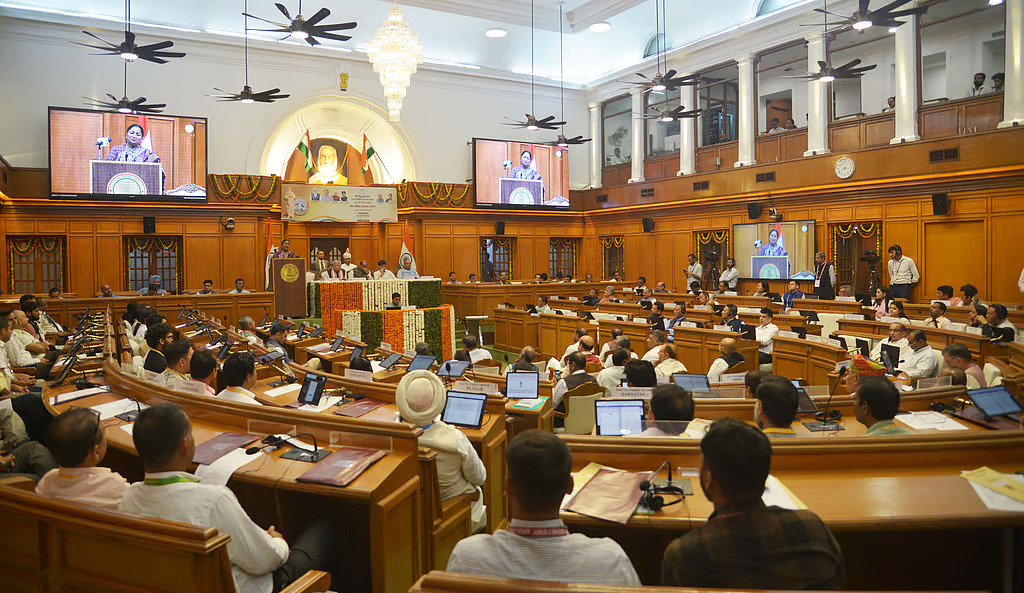
Against this backdrop, the Delhi Jan Vishwas (Amendment of Provisions) Bill, 2026 was introduced and passed on 9th January 2026 to reform Delhi’s legal framework. The Bill amends multiple Delhi-specific laws governing industries, commercial establishments, electricity regulation, agricultural markets, and water services. Its core objective is to remove imprisonment clauses for minor offences and introduce monetary penalties and civil enforcement mechanisms instead.
Amendments across multiple Acts including:
Delhi Industrial Development, Operation and Maintenance Act, 2010
Delhi Shops and Establishments Act, 1954
Delhi Electricity Reform Act, 2000
Delhi Agricultural Produce Marketing (Regulation) Act, 1998
Delhi Water Board Act, 1998
Objective of the Bill
The Bill aims to promote trust-based governance, enhance ease of living and ease of doing business, and improve regulatory efficiency by:
Decriminalizing minor and non-serious offences
Reducing compliance costs and fear of prosecution
Shifting enforcement from punishment to deterrence and correction
Key Provisions
Decriminalization of Offences: Imprisonment clauses under several Delhi Acts are replaced with graded civil penalties and monetary fines.
Sector-wide Amendments: Changes are introduced across laws governing industries, shops and establishments, electricity regulation, agricultural markets, and water services.
Adjudication Framework: The Bill establishes Adjudicating Officers to conduct inquiries and impose penalties, ensuring due process and administrative accountability.
Appeal Mechanism: Appellate authorities are designated to provide time-bound remedies against penalty orders.
Simplified Recovery: Civil penalties are recoverable as arrears of land revenue, ensuring enforceability without criminal proceedings.
Removal of Redundant Provisions: Several outdated and overlapping penal sections are omitted to streamline regulation.
Expected Outcomes
Reduced Litigation: Fewer criminal cases for technical violations, easing pressure on courts.
Improved Compliance: A non-punitive approach is likely to encourage voluntary compliance, particularly among small businesses.
Administrative Efficiency: Faster resolution of disputes through quasi-judicial mechanisms.
Citizen-Centric Regulation: Less harassment and greater predictability in enforcement.
Policy Significance
The Bill marks a decisive shift from a control-oriented regulatory regime to a facilitative governance model. By aligning enforcement mechanisms with proportionality and administrative fairness, it strengthens regulatory legitimacy while preserving deterrence through civil penalties.
Way Forward
To maximize impact, effective implementation will require:
Capacity building of adjudicating authorities
Clear penalty guidelines to avoid discretion misuse
Periodic review of penalty structures to ensure proportionality
Conclusion
The Delhi Jan Vishwas (Amendment of Provisions) Bill, 2026 represents a meaningful step towards modernizing state-level regulation. If implemented effectively, it can serve as a model for sub-national decriminalization reforms across India.