
The Rupee Under Pressure, The Reserve Fortified: How India’s Golden Safety Net Absorbs West Asian Shocks
The West Asia conflict is no longer just a regional crisis, as its impact can be felt in countries like India through higher oil prices and market uncertainty.
OPINION
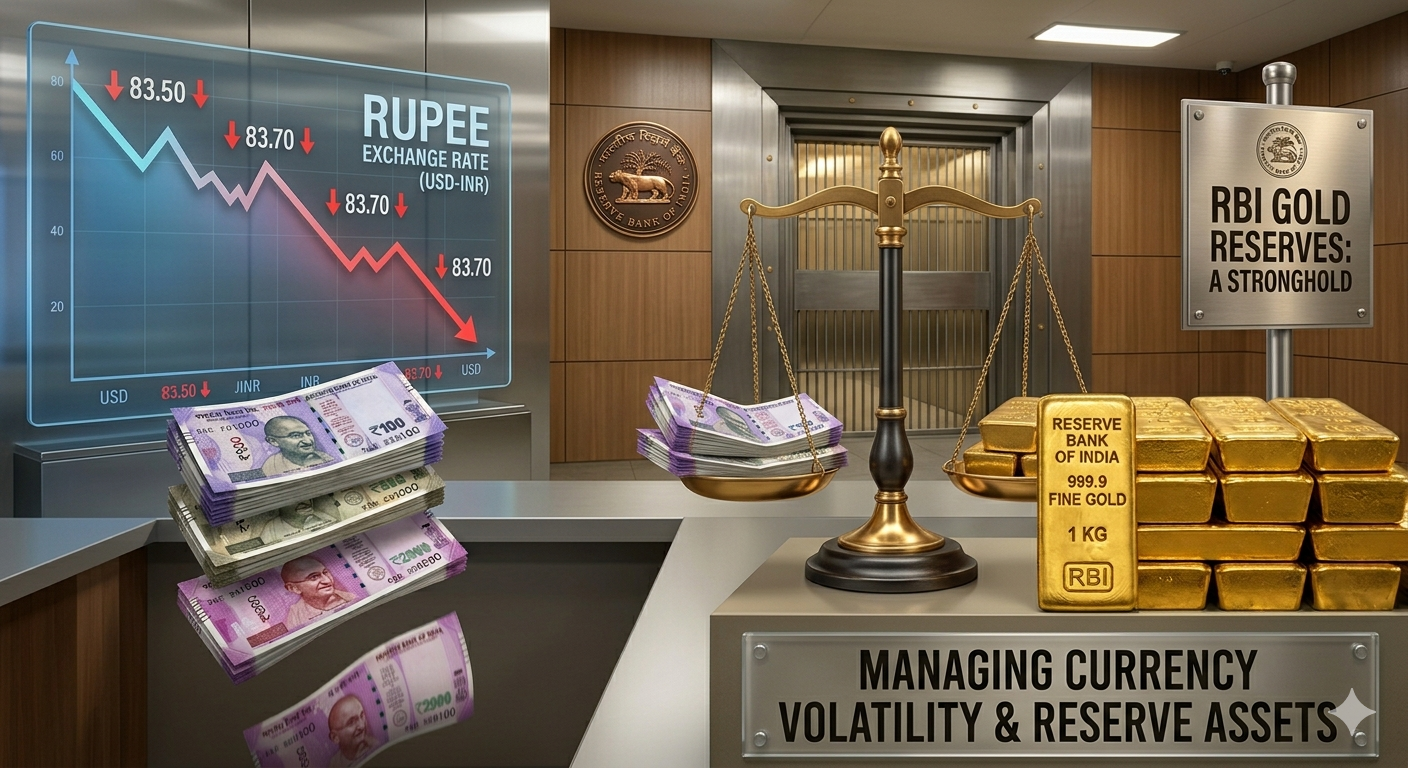
The ongoing West Asia crisis has once again demonstrated how conflicts beyond India’s borders can directly affect its economy and strategic interests. As a country heavily dependent on imported crude oil (nearly 85% of its requirements), India remains highly sensitive to instability in oil-producing regions. Its effects are already visible in our pockets, with pressure on the Indian rupee, rising crude oil prices, and inflation fears. The West Asia conflict is no longer just a regional crisis, as its impact can be felt in countries like India through higher oil prices and market uncertainty.
A Familiar Economic Shock
This is not the first time India has faced economic pressure arising from international conflict and energy market instability. India has been facing a drastic economic decline. Even at that time, India was heavily dependent on imported oil (60% during periods of international conflict and energy instability. One of the major examples was the 1990 Gulf War, when Iraq’s invasion of Kuwait caused global oil prices to70%, and India faced severe economic stress. What we later saw was how foreign exchange reserves declined rapidly, the rupee weakened, and then eventually the country entered the Balance of Payments crisis of 1991. India was forced to promise its gold reserves to secure emergency loans, which led to the start of major economic reforms in 1991. A more recent example is the Russia-Ukraine conflict that disturbed global energy markets, increased inflation, and weakened several import-dependent economies. These episodes demonstrate that countries heavily dependent on imported energy often bear the greatest economic costs when strategically important regions become unstable.
Why The Rupee Is Under Pressure
The current crisis in West Asia, particularly the conflict countries such as Iran, Israel and regional armed groups, has once again created instability in global markets. Investors and the government fear disruptions to critical oil supply routes, such as the Strait of Hormuz, through which nearly one-fifth of global oil consumption passes. These disruptions tend to increase global crude oil prices. With the rise of oil prices, countries like India face higher import bills, putting extra pressure on the value of their currencies. During these times of uncertainty, investors try to shift their money towards safer assets such as the US dollar and US treasury bonds. This strengthens the dollar globally while weakening the developing market economies, including the Indian Rupee. Due to this, pressure on domestic currencies increases. Hence, it is not only the higher oil prices but also changing global market prices and global market sentiment that depreciate the rupee.
The Cost of a falling currency
A weaker rupee makes imports more expensive, increasing costs for businesses and consumers alike. Higher fuel and input costs often translate into inflation, reducing household purchasing power and placing pressure on wages and economic growth. Along with these, other sectors such as aviation, capital goods, chemicals, internet and commercial vehicles will also feel the knock-on effects.
India is not the only one that is bearing the consequences of the crisis. Many Asian economies, such as Japan, South Korea and China, depend heavily on imported energy and are similarly vulnerable to disruptions in West Asia. Since a significant share of the world’s oil passes through critical routes such as the Strait of Hormuz, instability in the region has affected a major part of the world.
RBI’s Balancing Act
During such periods of volatility, the Reserve Bank of India (RBI) steps in to prevent the fall of the rupee. The RBI often intervenes through foreign exchange reserves and monetary measures to limit excessive currency volatility. These measures may provide some relief, but if global tensions continue for long, the impact is limited. In such unstable conditions, it usually becomes harder for the RBI to keep currency stable while also managing inflation and economic growth.
Building Long-Term Economic Resilience
Despite these challenges, the current crisis forces us to think and act upon India’s long-term economic strategy. The most important requirement should be to reduce the huge dependence on imported energy. This can be done by expanding renewable energy capacity and investing in domestic energy infrastructure. These steps would help and make India ready to manage domestic requirements amid the global crisis. India has made notable progress in solar energy and green hydrogen initiatives, yet the crisis highlights how closely energy security remains linked to economic security. India must also strengthen its strategic petroleum reserves and diversify crude oil sources to reduce excessive dependence on politically unstable regions.
Another important area is the diversification of trade and payment systems. India has recently explored conducting trade in local currencies with certain countries to reduce dependence on the US dollar. Recent trade arrangements with Russia and the United Arab Emirates illustrate this approach. Also, after Western sanctions on Russia, India started purchasing large amounts of Russian crude oil with payments in rupees and rubles instead of dollars. Although such mechanisms cannot immediately replace the dollar-dominated global financial system, they provide important steps towards reducing external currency vulnerability and improving India’s economic resilience during a global crisis.
Conclusion
The Falling Rupee is more than a financial indicator; it reflects the extent to which geopolitical instability can shape economic outcomes. While India cannot prevent conflicts beyond its borders, it can reduce their economic impact through greater energy security, different trade arrangements and its ability to handle economic crises. The current crisis highlights that economic preparedness and national security are increasingly interconnected in an era of global uncertainty.


Shreya Mishra is an independent researcher and public policy professional.